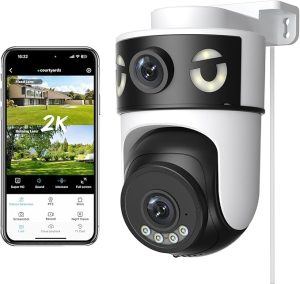
By 2025, smart surveillance technologies could become ubiquitous in France, with deployment accelerating—especially using the Olympic Games as a testing ground.
This evolution raises critical questions: how can public safety be balanced with individual freedoms? Cameras that automatically analyze behavior are dividing public opinion.
This article explores the 7 facets of Algorithmic Video Surveillance (AVS), from technical challenges to societal impacts, to reveal what lies ahead.
Key Takeaways
- France is accelerating adoption despite controversies.
- The 2024 Olympics served as a testing ground for these technologies.
- A national debate exists between security and privacy.
- Legal frameworks are evolving rapidly.
- Real effectiveness remains under study.
Introduction: What is Algorithmic Video Surveillance?
A new form of surveillance is transforming public spaces into connected environments. These systems go far beyond traditional cameras, analyzing every movement automatically without human monitoring.
Definition and Functionality
According to the CNIL, AVS is “real-time automatic analysis of video images by software.” Algorithms detect behaviors considered suspicious (loitering, large crowds, etc.).
The difference from traditional surveillance? Automation. Human operators no longer watch feeds continuously; the system only alerts in case of anomalies.
“These technologies create a blurred line between security and social control.”
Adoption Context in France
Since 2015, cities like Toulouse and Marseille have been testing AVS. Today, between 50 and 100 municipalities reportedly use it, according to La Quadrature du Net.
Cameras are often installed discreetly. Few municipalities communicate openly about their full extent. Yet Urban Supervision Centers (CSUs) are becoming key hubs.
The legal framework remains unclear. Some call it “augmented video,” others decry mass surveillance. Debates have intensified ahead of the 2024 Olympics.
Advantages of Algorithmic Video Surveillance
AVS brings tangible benefits, making video surveillance more effective than traditional methods.
Improved Public Safety
Algorithms detect anomalies in real-time. Abandoned objects are identified in 2.8 seconds according to Briefcam.
Continuous video analysis surpasses human monitoring, alerting for risky behaviors like fights or thefts.
Optimized Police Resources
CSUs gain efficiency. Two-I reports a 35% reduction in required personnel.
Another advantage: video condensation. Twelve hours of footage are summarized in 2 minutes, accelerating post-event investigations.
“These tools allow focusing interventions on true emergencies.”
Use Case During the Olympic Games
The event will test AVS at scale, handling nearly 3,000 alerts per day. Integration with RATP and SNCF will optimize transport safety—a first for the Olympics.
Risks and Downsides of AVS
Beneath the promise of safety lie major threats to fundamental rights, fundamentally changing our relationship with public spaces.
Threats to Individual Freedoms
Automatic behavior analysis changes habits. A study shows 68% of people avoid certain areas for fear of being monitored.
Facial recognition is especially problematic, identifying anyone without consent, even during routine movement.
Discrimination and Algorithmic Bias
Errors are concerning: around 40% of alerts involve normal situations, like waiting for a bus.
Worse: 73% of alerts target marginalized populations. Homeless individuals have been flagged as “abandoned objects.”
“These tools replicate their designers’ biases, creating two-tier surveillance.”
Lack of Transparency and Democratic Oversight
Source code remains secret, making it impossible to audit these algorithms. Their societal impact warrants citizen oversight.
Facial recognition advances without public debate, raising concerns even for the CNIL.
AVS Deployment in France: From Experimentation to Generalization
Several French cities have been actively testing AVS, prompting debates on usage rules and social impact.
Laboratory Cities
- Toulouse with IBM (pedestrian flow analysis)
- Marseille: €8M contract with Briefcam
- Paris preparing for the 2024 Olympics
These systems monitor nearly 90% of central public spaces. Municipalities praise efficiency, but citizens question the societal impact.
A Market Dominated by Foreign Players
87% of software comes from non-French companies (Briefcam – Israel, Two-I – USA).
The business model relies on:
- Software license sales
- Cloud service subscriptions
- Operator training
“These companies directly influence security policies without democratic control.”
Legal Framework Under Construction
The “Transport Security” law aims to extend AVS, but CNIL opposes several vague provisions. Since 2020, 42 appeals have been filed, often ruling in favor of plaintiffs due to unclear legislation.
The Digital Recovery Plan funds these projects with €200M, highlighting a paradox that fuels controversy.
Future Perspectives and Challenges
The future of smart surveillance raises fundamental societal questions.
Towards Widespread Facial Recognition?
The PARAFE project plans to equip 12 French airports by 2025. Yet 68% of French citizens oppose it (IFOP).
Tools analyze faces in real-time, boasting 99.7% accuracy, though errors persist.
- Risks of mass population profiling
- Possible expansion to commerce and transport
- Exportation to authoritarian regimes
“Facial recognition creates a society where everyone is potentially suspect.”
The Olympics as a Catalyst
The Games accelerate AVS deployment, with 3,000+ intelligent cameras planned. Data collected will shape future policies.
Citizen Resistance and Mobilization
Amnesty International gathered 230,000 signatures. Groups like Technopolice organize actions.
Emerging alternatives include:
- Participatory security budgets
- Independent algorithm audits
- Moratorium on facial recognition
Public debate is essential to balance security and freedom.
Conclusion: AVS Needs Urgent Regulation
A 2024 CNIL report shows 92% of AVS systems fail to comply with GDPR. A key amendment was rejected in April 2025.
While AVS can enhance security, risks to freedoms remain high. A moratorium on new installations and coordinated European regulation appear necessary.
Action Points:
- Educate the public on digital risks
- Upcoming 2026 municipal elections could reignite the debate
- Transparency and collective action are critical
The balance between innovation and fundamental rights cannot wait.